Coming from a long history of playing the game, starting in 1994, I have spent most of my time cubing with people that either started around the same time as I did or started as a young person and have developed into playing cube well after they put in their time learning the fundamentals. One of the things I did not foresee as I started organizing cube was that eventually people would show up who did not know how to play Magic. We have frequently had people join us who had never drafted a cube before and that was easy enough to accommodate because they understood the fundamentals of the game and could usually lean on the people around them while figuring out the rest.
More recently, one of our younger players has started bringing friends, and the experience level started moving further toward the beginning. One had some fundamental knowledge of the game, while another showed up having never played before. Before his first time playing with us, we spent time explaining what it meant to tap a card, how casting costs worked, and the phases of a turn. We had a full pod show up to draft that evening, which normally means we have exactly what we need for a cube draft, but as many have said before, cube is not a suitable way to teach a new player how to play the game, and this required a modified approach.
As we were talking about how we were going to set up the draft, they suggested that they could just watch, which was their way of trying to not disrupt the group, more so since it was the first time they had met many of us. The experienced players could draft and they could sit beside their friend and see how the game worked. I brought my hand down hard to the table with a crack and said, “No way, you can’t learn this game by watching!” So instead, we split the pod. Half the group sat down and drafted a cube while the rest of us pulled out a Battle Box I had brought with me just for this situation.
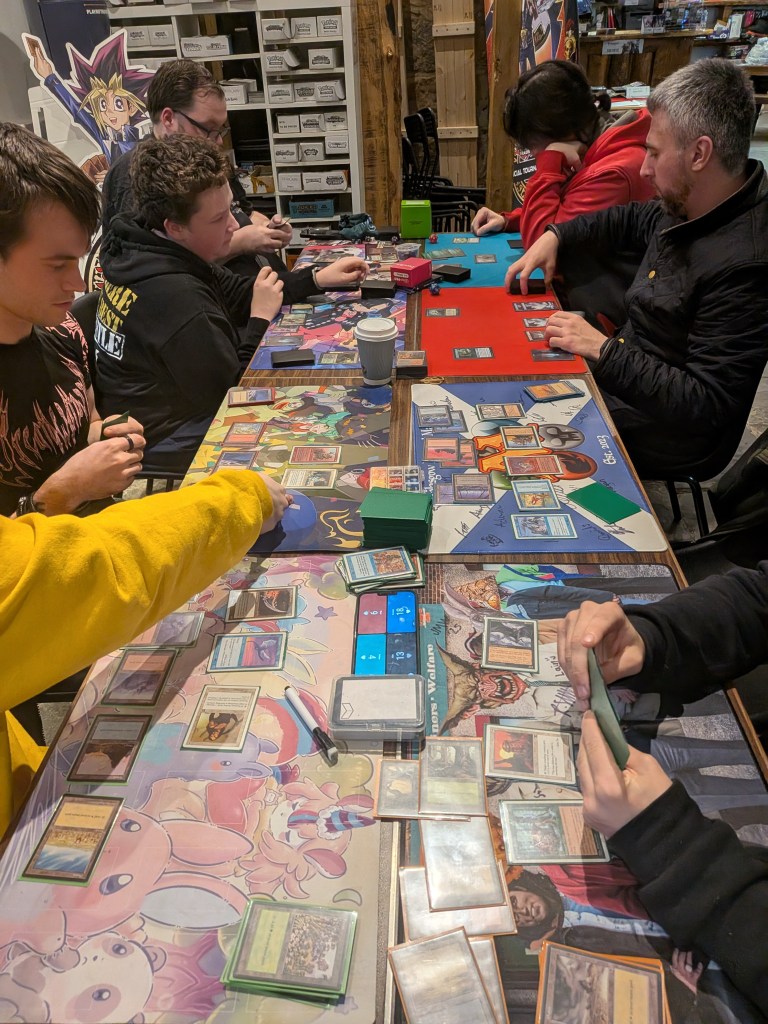
Splitting the pod meant that the experienced players could draft at the pace they were used to without waiting for someone to read every card or work out what the symbols in the upper-right corner meant, while we could take as long as necessary to explain the fundamentals. It was the second time we had split the pod based on experience and it has become an incredibly useful tactic to maximize fun for everyone at the table. Nobody had to sacrifice the experience they came for and, more importantly, the new player did not spend the evening watching other people play a game they wanted to learn with nothing to do except ask questions.
Experienced players can find their first cube draft overwhelming because knowing how to play the game and applying those skills to a draft are two very different things. A new drafter needs to evaluate cards relative to one another and build a deck from what they selected before they play their first game. For someone new to the game, there is simply too much cognitive load involved and too much happening to learn successfully in this environment, much less have an enjoyable experience.
My own introduction to cube is a useful reminder that this problem does not disappear simply because someone knows how to play Magic. I had played for years before my first Old School cube draft and understood the cards in front of me, but I still went 0–3. The problem was not that I did not understand what the cards did, I did not understand how to evaluate those cards inside a draft environment. I needed a different lens and had to develop it through repeated drafts. This has made me curious about whether that lens needs to come later in a player’s development. The younger players joining us now have an opportunity to approach Magic from a completely different direction than I did. As a result, we have inadvertently found ourselves breaking the process into smaller pieces to advocate their attendance rather than turning them away and asking them to come back after they had learned how to play.
I’ve seen evidence that learning to play through limited can work. A previous GLM member who found us through our Reddit activity while spending a year in Glasgow had been playing Magic for a few years but had learned primarily through retail Limited and did not have the same Commander or constructed background that many players bring into cube. He drafted with us almost every week while he was here and consistently finished in the middle or the top of the pod each time. Card evaluation and building a deck on the fly were not skills he had to add on top of his foundational understanding of Magic because those things were the foundation. Similarly, drafting an unfamiliar pile of cards did not require him to shift into a completely different way of thinking about the game because that was how he had learned to play in the first place. Watching him made me think about what might happen if Limited is not treated as somewhere a player eventually arrives but where they can start their journey in a curated way.
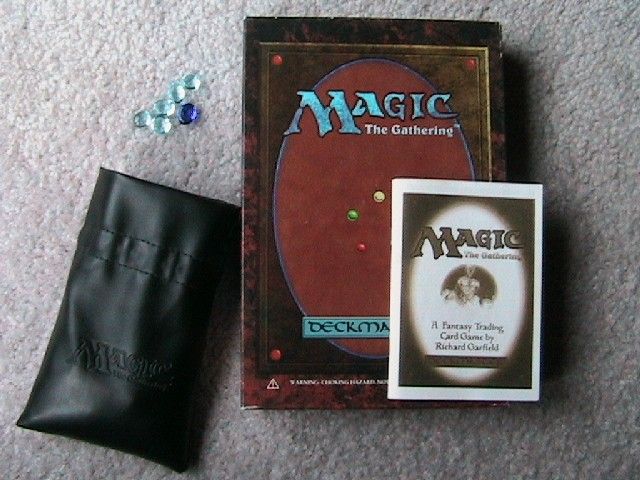
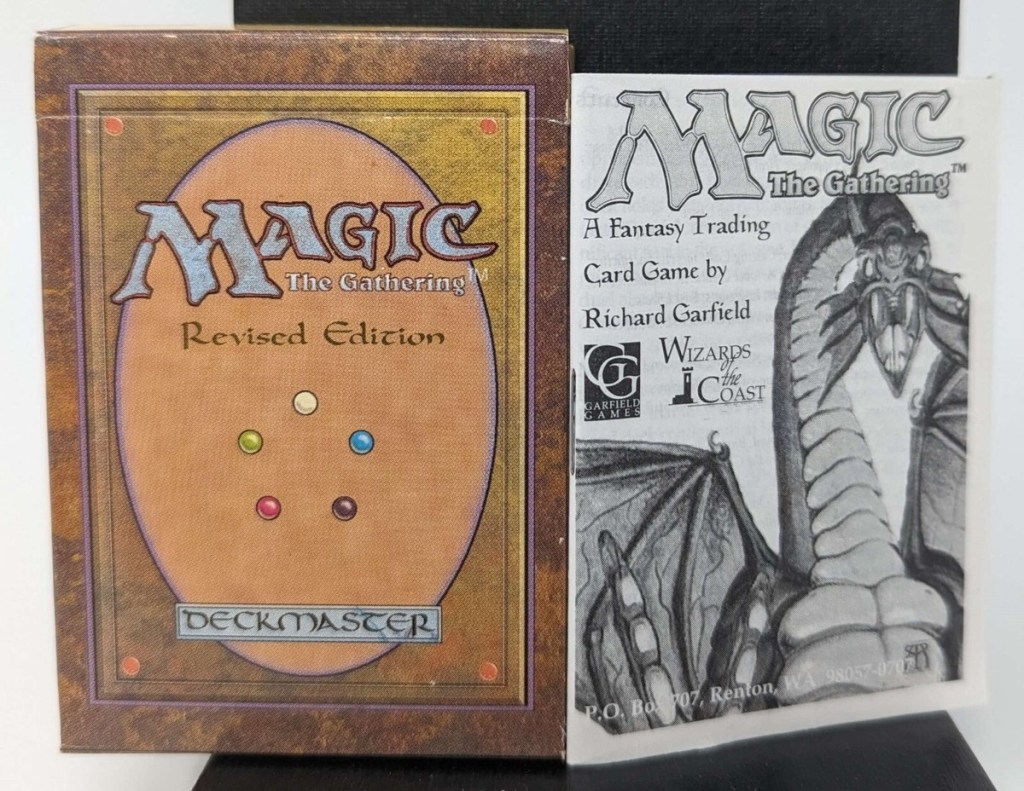
One of the most useful tools I have found for bridging this gap was not originally designed as a teaching tool. I built a modified Battle Box after receiving a collection from a friend because I wanted to recreate a very specific experience from when I started playing. Starter decks in the early 90s were not carefully curated introductions built around a particular strategy. You opened a box containing cards across all five colours, a pile of basic lands, and a very random mixture of creatures and spells that did not necessarily make any sense sitting side by side. The decks did not have any featured archetypes or a plan; you had the random cards that came in the box. Then you bought booster packs when you could afford them after mowing your neighbour’s lawn and slowly replaced some of the tat with better cards you opened.
The Battle Box was supposed to recreate that feeling for those of us that opened up these decks back in the day. The shared library begins with white-border cards pulled from starter decks across the Premodern era, so things like Bog Rats can exist alongside a Serra Angel. As black bordered booster packs enter the environment, the difference in power becomes increasingly relevant. The new cards that get added to the pool each game are reminiscent of how your decks as a kid got better as you opened new packs. The contrast is part of the experience I was trying to recreate because that is what opening packs felt like when I was young. There is also an additional element of card evaluation as players can keep five specific cards from each booster they open to cast later in the game. For those interested in looking at the project, you can find the overview here, which explains how the box runs. I had not considered that this throwback to my youth, combined with the shared resources of Battle Box, would also make it a useful tool to progressively learn how to play Magic in a limited environment.
One of the best parts of this meta is that a new player does not need to build a deck before playing and just as importantly, does not need to own anything. The land station means they do not need to understand how to construct a mana base, and for the first three turns they can play a land and draw a card without having to make a resource decision. With this structure, we can concentrate on the fundamentals of the game. When something goes wrong, we can rewind and explain what happened. Sometimes we let the mistake stand because making it is probably the best way for them to learn why they should do something different the next time. The environment gives us enough room to work through those decisions without the pressure of a draft where experienced players are sitting down to play capable opponents.
The first time I realized that some of this might actually transfer happened when one of our newer players sat down to draft my 93/94 Ante Cube. He had come to us primarily from Commander, had drafted with us a few times and had played the Battle Box as an introduction to limited. I took a look at his deck after the draft and immediately realized that he had fallen into the same trap I did the first time I drafted an Old School cube. He had ended up in WG, which can look like an incredibly inviting lane because there are plenty of playable cards in both colours, but many of those cards function better as support for other strategies than as the foundation of a deck themselves. There was something reassuring about recognizing the mistake because it was not some uniquely bad decision made by a new player, it was an extremely familiar one.
As I watched him play, I started noticing the cards he had chosen and where those choices had come from. He had seen Stormseeker deal a huge amount of damage in the Battle Box the week prior and drafted it when it appeared. He had used Instill Energy to let a large creature attack while still remaining useful on defence and brought that same interaction into the draft. Samite Healer had repeatedly demonstrated how annoying damage prevention could be in the Battle Box, so when he saw Combat Medic, recognized the mechanic and drafted it. None of these were examples of someone suddenly mastering an Old School draft environment, but they were examples of someone taking information learned in one Limited environment and applying it to another. He eventually won two games against experienced players, which was two more than I managed the first time I drafted an Old School cube and, most importantly, at the end of the night he said that he had fun.
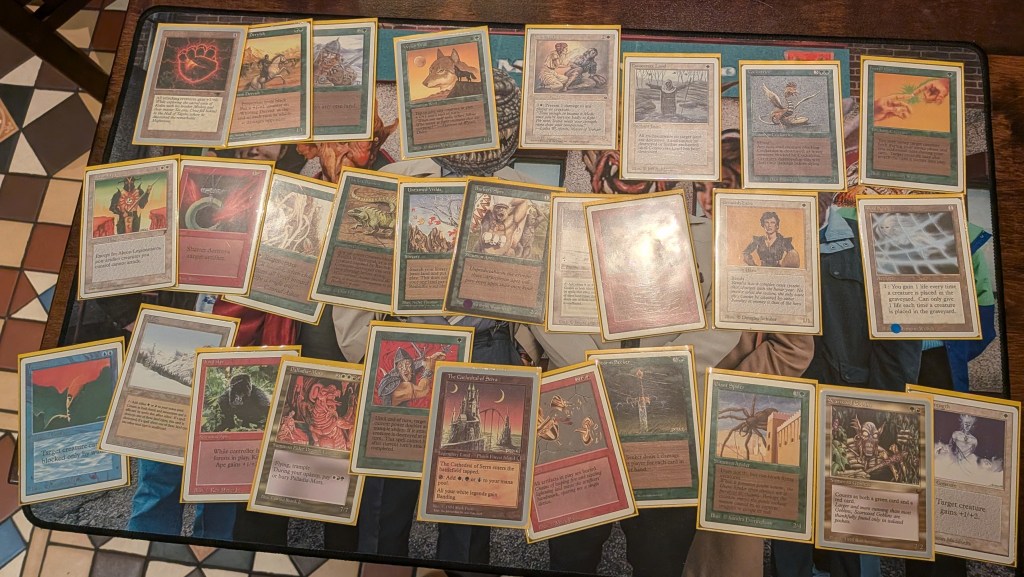
Afterward, we talked about the WG trap and I told him that while he had made the same mistake I did, he had done better with it than I had. He was already looking for things he had seen work elsewhere and applying them to the cards in front of him. At the same time, he had passed me a Mox Ruby in pack one, so there was still an enormous amount of contextual knowledge missing. I love that these two things happened in the same draft because they show different parts of the learning process. Someone can fail to recognize one of the most powerful cards in the cube while simultaneously beginning to develop useful Limited instincts.
We got another opportunity to test that theory the next week, although not in the way I had planned. The player who had previously arrived expecting to watch showed up again and decided that he wanted to draft. I had been thinking about using the Battle Box again, but there was no reason to stop him because he had decided he was ready to try. There is no “rank test” for this and I have no interest in inventing an initiation ritual someone has to pass before they are allowed into a cube. If someone understands enough of the basic mechanics to get through a game and feels ready to sit down with packs, that is probably as useful a measure of readiness as anything I could create.
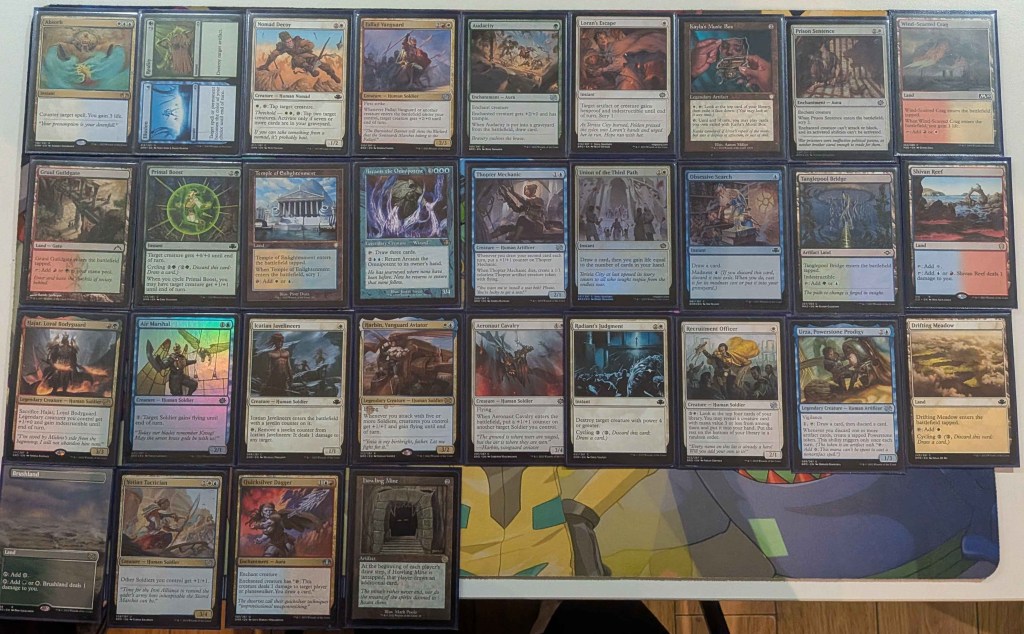
He drafted a Soldiers deck. I would not describe it as particularly good and he went 0–3, but there was a recognizable plan holding the cards together and he had built something he was excited to play. After the draft, I helped him make sure the deck was constructed reasonably, sorted out the mana base, and then played our games with our hands face-up. I could see his cards, he could see mine, and instead of hidden information becoming another thing he had to interpret, we could talk about every aspect of each game directly. We could stop before he missed an opportunity to cast an instant and talk about whether there was a reason to wait. When a creature was in danger, we could look at the options in both hands and work through how he might protect it. Other experienced players did the same thing with him across the night, and over the course of those games he even managed to take a game off me because of these guided interactions. All in all, the night was a success and he has since drafted with us again with better results.
Having younger players join GLM who are learning to play has also stirred up a lot of memories and emotions as the group continues to grow. When I learned to play Magic the environment I learned in was very different than what we are trying to cultivate with these newcomers. In 1994 as a pre-teen kid, Magic was absolutely not a kids’ game in the way that it has become accessible to younger players now. Ante was the normal way to play and older teenagers and young adults were perfectly happy to bring much better decks and beat younger kids (me) out of their cards. My allowance was effectively nothing, most of the cards I had were given to me by other kids, and unsurprisingly those cards were not particularly good. One of my friends who introduced me to Magic was a year older, had a brother who was fifteen or sixteen, and had parents that supported his engagement in CCGs, so he had access to more cards and information than the rest of us.
Most of our actual learning happened on sidewalks (without sleeves) with the little rule books that came in the starter decks. We read the rules, got things wrong and argued about how cards worked. I used to hang around one of the few shops that sold Magic cards called Book Source in Austin, always hoping I could find somebody willing to play with me. As an excited kid stoked to play as much Magic as possible, I am confident I was absolutely insufferable. I talked constantly about my deck and my cards to anyone who was unfortunate enough to be standing near me. One day the guy behind the counter finally told his assistant to “please play this kid so he will shut up.” He beat me in what felt like record time, and I left the shop embarrassed and afraid to play there again. I had gone to the shop because I desperately wanted somebody to play Magic with me, and when I did finally get a chance to play, the experience convinced me not to ask again.
The environment we built among ourselves on the sidewalk was completely different. Once we figured out that we could play each other without ante and without dealing with hostile older players, that became what Magic was for us. We played on the playground and over lunch at school, inventing formats like mana dump so we could finish games while eating the sandwiches our moms had packed. I remember hot summer afternoons where we played multiplayer games in the grass by the pool and brought our decks to sleepovers with pizza, soda and movies. None of us had much money and we didn’t really know what we were doing, but it didn’t matter because we figured out a way to play that was fun. Looking at the Starter Deck Battle Box through this lens, I realize that what I initially built as a nostalgic recreation had preserved a lot of the parts of that experience I remember about learning how to play the game. What it does not recreate is having to own the cards or endure unnecessary abuse in the hopes that one day, “this will be fun”.
I have accumulated more than thirty years of Magic cards and experiences. When I was eleven, those kinds of asymmetries worked against me. Someone with more money had better cards could beat me and potentially leave with one of the precious few good cards I had managed to acquire. Given the net zero aspect of cube, I have the ability to turn that asymmetry in a different direction. A new player does not need to own anything to draft with us. If they make the same mistakes I made years ago, I can recognize it and explain what happened. No one has to lose cards or feel marginalised which hopefully means they will keep coming back to the table.
The first younger player who came to us with some Commander experience is now bringing his friends. One of those friends has already gone from learning the fundamentals of the game to drafting a Soldiers deck and sitting across from experienced players with his hand face-up while they talk through the decisions with him. Another has gone from Commander into multiple cube drafts and carried lessons from his first Battle Box games into an Ante Cube draft and started winning games against people who have been playing Magic much longer than he has. It has been very gratifying to see how a progression starting with a simpler Limited format like Battle Box can help slowly remove the skill gaps that exist between learning the fundamentals of the game and learning how to evaluate cards and build a 40-card deck on the fly.
I have had the opportunity to understand that one of the most important variables in the equation is patience as much as process. While the energy and effort required to get these players to a point where they can feel confident drafting with the rest of the group is substantial, we are all searching for ways to bring more people into our niche corner of the hobby. There are a lot of reasons to preserve the inner circle of seasoned players that keeps the experience consistent from week to week and philosophically, this has been something I have had to spend a lot of time thinking about as I am on one hand trying to build a thriving community that drafts every week but on the other hand trying to capture a prescribed experience with that group of people. There is inherent conflict within these two objectives, and trying to find a way to close that chasm has been a fun challenge for which Battle Box has provided a good medium for experimentation.


Leave a Reply